Read before the PO
A pen injector is not a generic plastic part.
Sourcing an injection pen platform is fundamentally different from sourcing a generic plastic component. A pen injector sits at the intersection of precision mechanics, materials science, human-factors engineering, and regulatory documentation — and the manufacturer behind it determines whether a brand’s device program ships on time with consistent dose accuracy, or stalls in tooling rework and audit findings.
This guide is written for distributors, pharma buyers, and therapy brands evaluating a Chinese injection pen manufacturer for a disposable or reusable OEM/ODM program. It covers the engineering fundamentals of pen platforms, how disposable and reusable architectures compare, the manufacturing flow from mold development through cleanroom assembly, how to evaluate a contract manufacturer, the quality checkpoints that matter, the OEM/ODM customization workflow, and the operational questions — MOQ, samples, lead time, packaging, branding — that come up in nearly every sourcing conversation.
From a manufacturing perspective
What an injection pen is, on the factory floor.
Marketing materials describe injection pens in terms of comfort and convenience. Engineering teams and quality departments look at a different set of variables: dose-dial torque and detent feel, spring-driven injection force curves, needle-hub interface tolerances, and cartridge or reservoir compatibility. These are the parameters that actually determine whether a pen platform is manufacturable at scale.
Dose dial and rotational damping
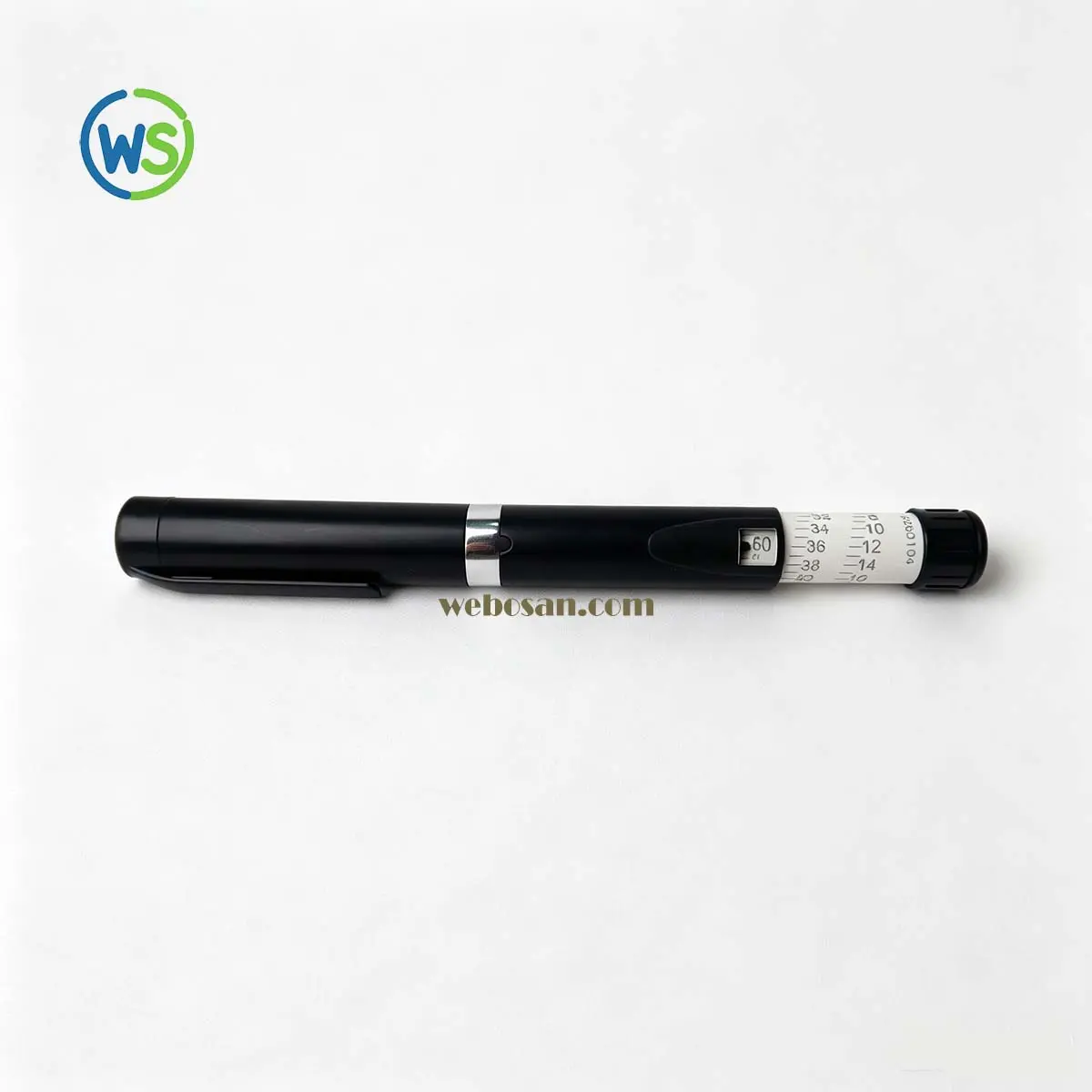
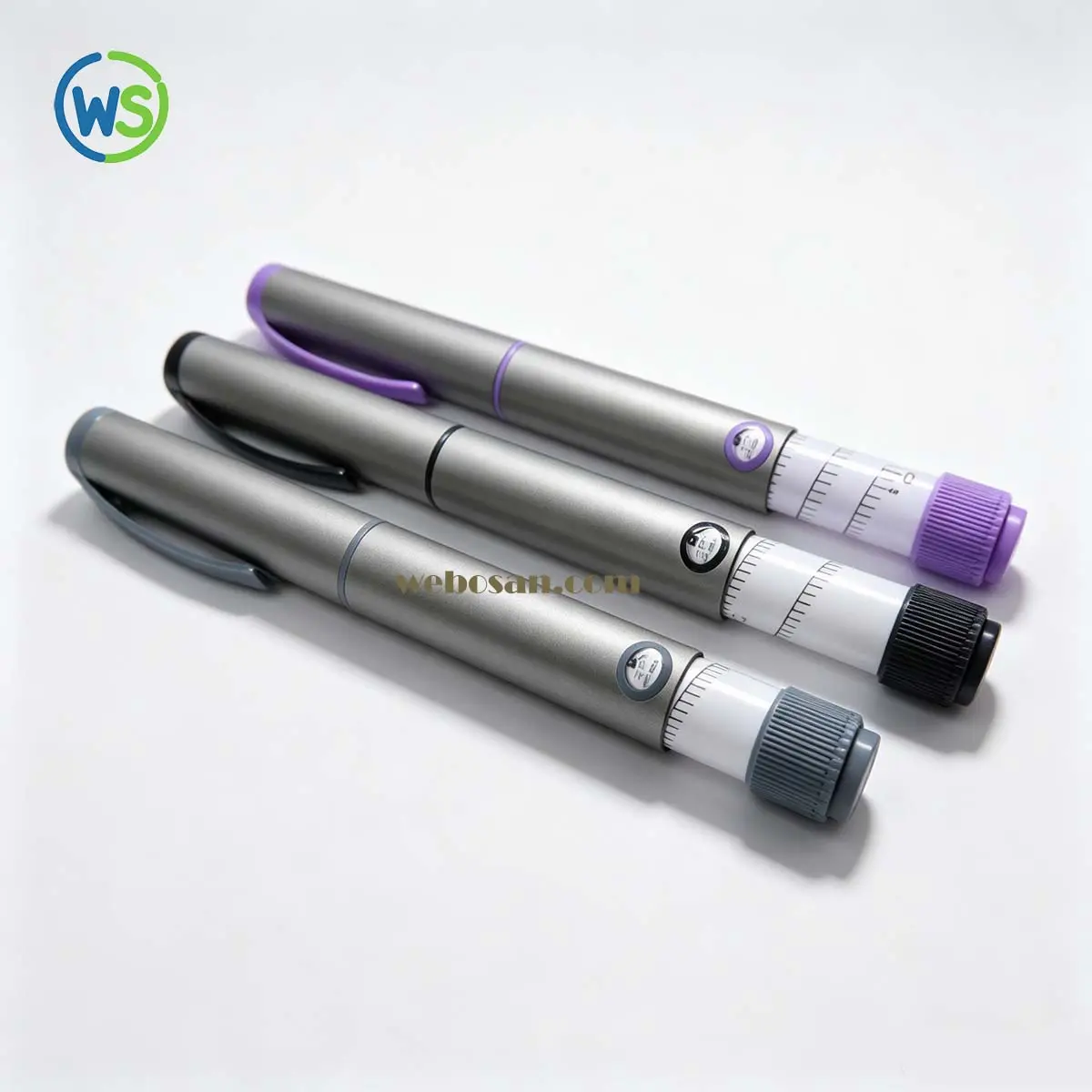
The dose-dial subassembly is the most mechanically complex part of any pen injector — a threaded lead screw or rack-and-pinion arrangement with a click-stop detent that confirms each increment.
- Detent torque must stay in a narrow band across the full dial range and the full production lot.
- Damping — friction ring, viscous damper, or rib geometry — controls overshoot and perceived dose accuracy.
- Gear backlash must be tight enough that the dial cannot slip a partial increment.
Injection force and spring design
Once a dose is set, a compression spring or manual plunger delivers the dose. The force profile — how much builds, how quickly it releases, how consistent it is across the stroke — depends on:
- Stainless spring wire selected for fatigue life beyond the rated injection-cycle count.
- Plunger-rod and stopper friction, a function of barrel material and stopper coating.
- Cartridge viscosity assumptions — a platform tuned for aqueous formulations behaves differently with a higher-viscosity suspension.
Needle interface and hub compatibility
Pen injectors use a standardized universal thread (ISO 11608-2 defines the interface geometry) so they work with third-party pen needles. Manufacturing tolerance here affects:
- Leak-free seating between hub and cartridge septum.
- Consistent subcutaneous penetration depth.
- Cross-compatibility with the pen needle brands end users already have on hand.
Cartridge and reservoir systems
Most pens are built around a 1.5 mL or 3 mL pre-filled glass cartridge. Reusable platforms need a cartridge-holder that ejects and reloads without disturbing dial calibration — a detail that is easy to underestimate during platform selection.
Materials across the mechanism
Functional choices, not cosmetics
Housings
Polycarbonate or ABS for disposables; die-cast zinc and stainless for premium reusable shells.
Dial & gears
Acetal (POM) for low friction and dimensional stability across rated dial cycles.
Springs
Cold-drawn stainless wire, heat-treated for a fatigue life beyond rated injections.
Seals
Fluoroelastomer or silicone chosen for excipient compatibility and compression-set resistance.
Human-factors engineering is typically owned by the brand, but dial grip diameter, button actuation force, end-of-dose confirmation, and window legibility are locked in during mechanical design. A manufacturer experienced in pen platforms will flag these early — larger knurling, higher-contrast windows, a distinct end-of-dose click — so usability studies do not become late mold rework.
Architecture choice
Disposable vs reusable for B2B programs.
Choose early. Architecture drives tooling investment, per-unit cost, branding surface, and patient instructions.
Single-use
Disposable pen platforms
A disposable (prefilled, single-use or fixed-dose-count) pen is built around one cartridge and discarded after the drug product is exhausted.
- Fixed or narrow dose range — common in GLP-1 and high-volume chronic therapy.
- Lower device BOM per unit, spread across large prescription volume.
- No reprocessing, cleaning, or cartridge-loading instructions in patient labeling.
- Sealed, tamper-evident, ready-to-inject logistics.
Multi-cartridge
Reusable pen platforms
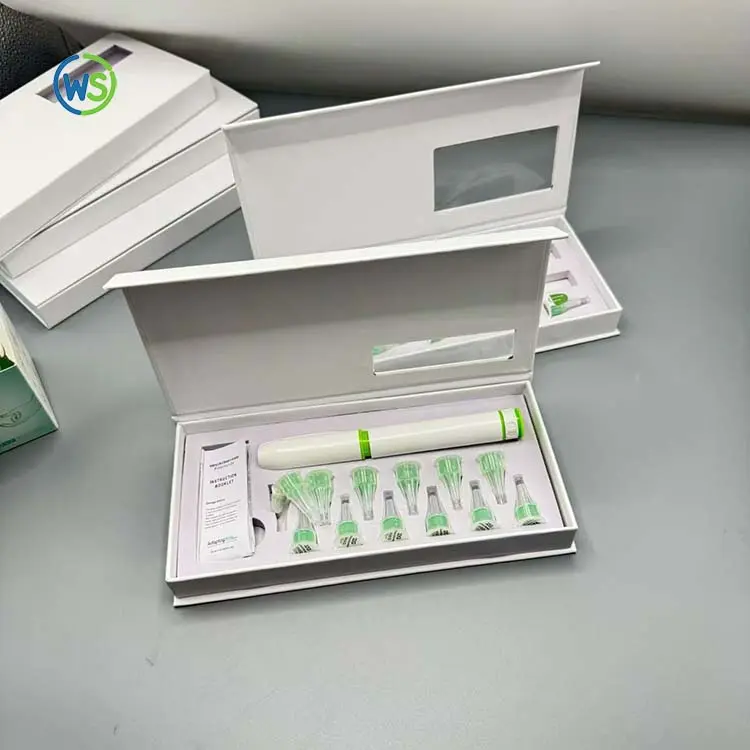
A reusable pen retains the drive mechanism, housing, and dose-dial across multiple cartridge changes. Only the cartridge and needle are replaced per cycle.
- Broad dose range or frequent titration.
- High per-cartridge drug cost, so device cost amortizes across many cartridges.
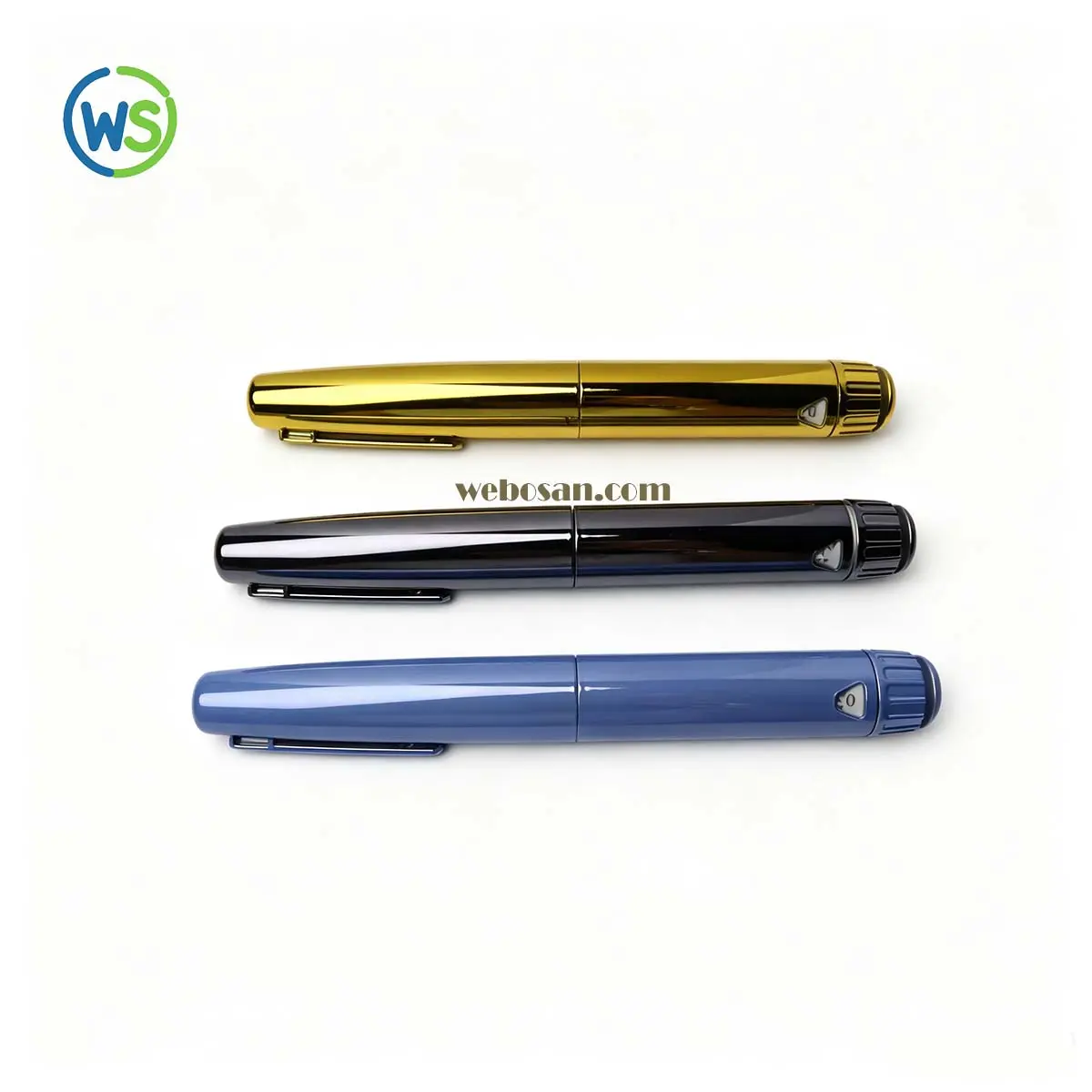
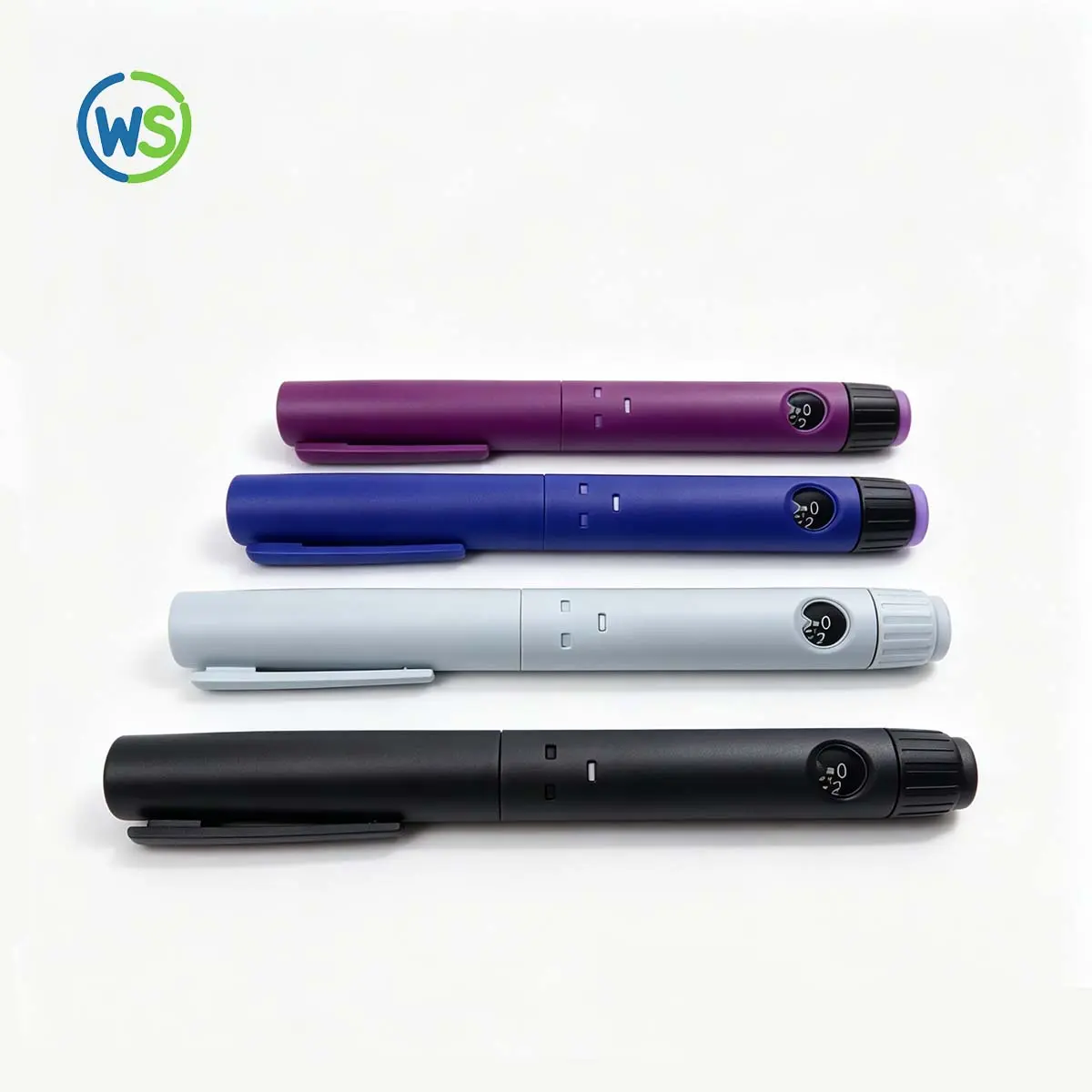
- Brand differentiation — electroplated metal, soft-touch, custom colour.
- Sustainability positioning: less plastic waste per dose delivered.
| Factor | Disposable | Reusable |
|---|---|---|
| Tooling investment | Lower, simpler mold set | Higher, more precision components |
| Per-unit device cost | Lower per pen | Higher per pen, amortized over cartridge life |
| Dial complexity | Usually fixed or narrow-range | Usually broader, adjustable range |
| Branding surface | Limited (single-use housing) | Extensive (long-term device, premium finishes) |
| Patient training burden | Lower (no cartridge swap) | Higher (cartridge loading, care instructions) |
| Best fit | High-volume chronic therapy, cost-sensitive programs | Premium brand positioning, high-cost drug products, sustainability-driven programs |
- Tooling amortization across expected volume before per-unit economics become clear.
- Packaging and freight density of pens versus pens-plus-cartridges.
- Field service and complaint profile — reusable devices stay in market longer.
- Cartridge cadence planned with the device program, not as a separate workstream.
Total cost of ownership, not just unit price — comparing disposable and reusable programs on device unit cost alone misses most of the relevant economics.
Gated process
From mold development to finished device.
Each stage has its own tooling, validation, and documentation requirements. Understanding the flow helps buyers set realistic timelines and know what to ask for at each gate.
DFM · T0/T1 · steel correction
Mold development
DFM of housing halves, dose-dial ring, lead screw, button, cartridge holder, springs and seals. Tolerance stack-up before steel is cut. Mold-flow simulation for weld lines and fill balance. T0/T1 sampling, then two to four mold-correction cycles against CMM and functional fit.
Lot-traced resin · in-process CMM
Injection molding
Production runs with resin lot traceability (PC, ABS, POM), first-article and in-process dimensional sampling, and cavity-to-cavity consistency checks so fill pressure or cooling imbalance does not create hidden dimensional drift.
Particulate · torque · force curves
Cleanroom assembly
Spring-loaded drive, dial subassembly, and needle-interface components assembled under environmental monitoring. Gowning, in-line torque / click-count / injection-force sampling, and work instructions under document revision control.
AQL · CoC / CoA · lot trace
Inspection and lot release
AQL visual and dimensional sampling, functional samples for dose accuracy, injection force, and detent torque, packaging integrity, then CoC / CoA tied to the lot number for the buyer’s incoming inspection.
Supplier evaluation
How to choose an injection pen contract manufacturer.
Switching suppliers mid-program means re-validating tooling, re-running human-factors studies, and potentially re-filing regulatory documentation. Evaluate these dimensions before the PO.
In-house tooling
Ask whether mold design, mold-flow, and tool correction are in-house. In-house engineers iterate faster during T0–T2 and own dimensional issues rather than acting as a middleman.
Cleanroom infrastructure
Confirm classification, environmental monitoring, and whether torque testers, force-curve rigs, and dose-accuracy fixtures are on-site and calibrated. Open-floor assembly is a red flag.
Platform depth
An established library of disposable and reusable base mechanisms is a faster, lower-risk start than a from-scratch design. Ask for prior OEM colourways, dial-range variants, and housing changes.
Documentation systems
Request redacted device master records, batch records, and change-control examples. Clean files on request predict how the factory will behave in your own audit.
Sampling speed
Evaluate response time to engineering questions, not only commercial ones. That is the proxy for mold-correction and complaint-handling later.
Supply-chain control
Springs, seals, and fasteners are often sourced. Confirm incoming inspection and approved-supplier lists — and whether critical items have qualified alternates.
IP protection
NDA terms, design-file access control, and tooling ownership should be explicit in the manufacturing agreement before detailed specifications are shared.
Operational stability
Capacity, backup tooling, and experience supporting multi-year, multi-million-unit programs versus one-off small batches.
Quality & regulatory
Checkpoints that matter — without overstating status.
The applicable regulatory pathway depends on the target market, the drug product, and how the device is sold. A capable manufacturer supports this process without overstating its own regulatory status.
ISO 11608 alignment
ISO 11608 covers needle-based injection systems: dose accuracy, functional performance, and design verification across rated use life. Ask which test methods are used internally and whether reports are available for review.
How dose accuracy is verified
A series of set doses — min, mid, max — into a calibrated vessel, across units and lots. Protocols should also cover start/mid/end of cartridge content, environmental conditioning, and end-of-life after the rated cycle count.
CE and FDA pathway awareness
The contract manufacturer’s role is project-dependent documentation — DHF, V&V data, biocompatibility, change control — that the brand incorporates into its own submission. Treat blanket “FDA approved” or “CE certified” platform claims as a warning sign.
Materials and change control
Patient- or drug-contact components should have resin certificates and ISO 10993 data where the contact class requires it. Post-launch, tooling, resin source, or process changes go through documented ECO with buyer notification.
Customization path
OEM / ODM workflow from platform to ramp.
Most buyers start from a validated platform and customize it for brand and therapy area. Cosmetic OEM is not the same timeline as new dial tooling.
- 1
Platform and requirements
Align on disposable or reusable base, dose range, cartridge format, known formulation characteristics, and branding — logo, colour, packaging concept.
- 2
Design adaptation and DFM
Colourway or logo may only need surface tooling or pad-print setup. A new dose range or housing geometry means gearing, spring, or core/cavity steel, then DFM before cutting.
- 3
Sampling and iteration
Dimensional and cosmetic approval first, then functional testing against the target spec. Most programs take two to four sampling rounds before a golden sample.
- 4
Design verification and pilot
A pilot batch under production-representative conditions validates molding parameters, work instructions, and inspection criteria before full-volume commitment.
- 5
Packaging and branding
Blister, carton, pen case, IFU, and dose logs are finalized in parallel so drop and seal tests run against the actual production device.
- 6
Production ramp
Standing runs against forecast, with lot traceability and quality systems running continuously across each lot.
Working with a manufacturing partner
A multi-year relationship, not a transactional PO.
An injection pen program is a multi-year relationship, not a single transactional purchase order. The manufacturer’s tooling decisions, cleanroom discipline, and documentation practices during the first sampling round set the trajectory for every production lot that follows. Buyers who invest time upfront in platform selection, factory evaluation, and documentation alignment consistently see shorter time-to-market and fewer field issues.